
You’ve built a successful business. You’ve won awards. You’ve been featured in local media. You think you’re ready for a Wikipedia page.
Then you submit your page and Wikipedia deletes it within 24 hours.
The reason? “Subject does not meet notability requirements.”
This happens thousands of times every month. Successful people, respected professionals, and established businesses get rejected because they don’t understand what Wikipedia means by “notable.”
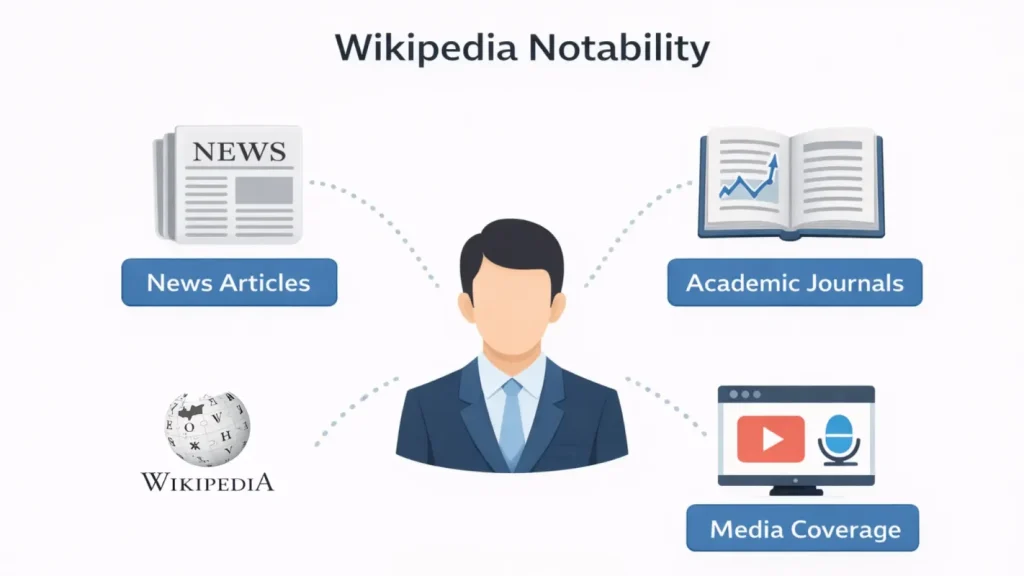
Wikipedia notability has nothing to do with success, wealth, or local fame. It’s about independent coverage in reliable sources. This guide will show you exactly what qualifies and what doesn’t.
What Does “Notability” Mean on Wikipedia?
Wikipedia notability is not about how important you think you are. It’s about whether independent journalists and researchers have written about you in reliable sources.
Here’s the core principle.
If reliable publications haven’t independently decided you’re worth writing about, you’re not notable by Wikipedia standards.
Notice the word “independently.” This means:
- The coverage wasn’t paid for
- You didn’t arrange the interview or send a press release
- The publication chose to cover you on their own merit
- The article provides significant coverage, not just a brief mention
Wikipedia uses this standard because it ensures articles are about subjects the world considers important, not subjects that simply want Wikipedia pages.
General Notability Guideline: The Foundation
Wikipedia’s General Notability Guideline (GNG) applies to all subjects. You meet it if:
You have received significant coverage in multiple reliable sources that are independent of the subject.
Let’s break down each part.
Significant Coverage
Significant coverage means the source addresses the subject directly and in detail. A brief mention doesn’t count.
Examples that count:
- A 1,500-word newspaper profile about your career
- A documentary that focuses primarily on your work
- An academic paper analyzing your contributions
- A book chapter dedicated to your achievements
Examples that don’t count:
- Your name mentioned once in a news article about something else
- A brief quote you gave to a journalist
- A list of award winners that includes your name
- Social media posts, even from verified accounts
Multiple Sources
You need at least 2-3 independent reliable sources. More is better.
One great article isn’t enough. Wikipedia wants to see sustained interest from multiple independent publishers over time.
If only one publication has covered you extensively, you probably don’t meet notability yet.
Reliable Sources
This is where most people fail.
Reliable sources have editorial oversight, fact-checking, and a reputation for accuracy. This includes:
- Major newspapers (The New York Times, The Guardian, national papers in your country)
- Academic journals and university presses
- Established book publishers
- Government publications and official records
- Well-known industry trade publications
- Unreliable sources that don’t count:
- Press releases (even if republished by news sites)
- Your company’s blog or website
- Social media platforms
- Self-published books or blogs
- Paid promotional articles
- Small personal blogs without editorial oversight
- Most local community news sites
For a complete breakdown of what sources Wikipedia accepts, read our guide on Wikipedia page creation.
Independent of the Subject
Independent means the source has no financial, personal, or professional connection to you.
Articles written by:
- Your employees or colleagues don’t count
- Publications you own or control don’t count
- Friends or family members don’t count
- Organizations you fund don’t count
This is why most entrepreneurs struggle. Their company blog, their LinkedIn posts, and articles they commissioned don’t help establish notability.
Notability Requirements for Individuals
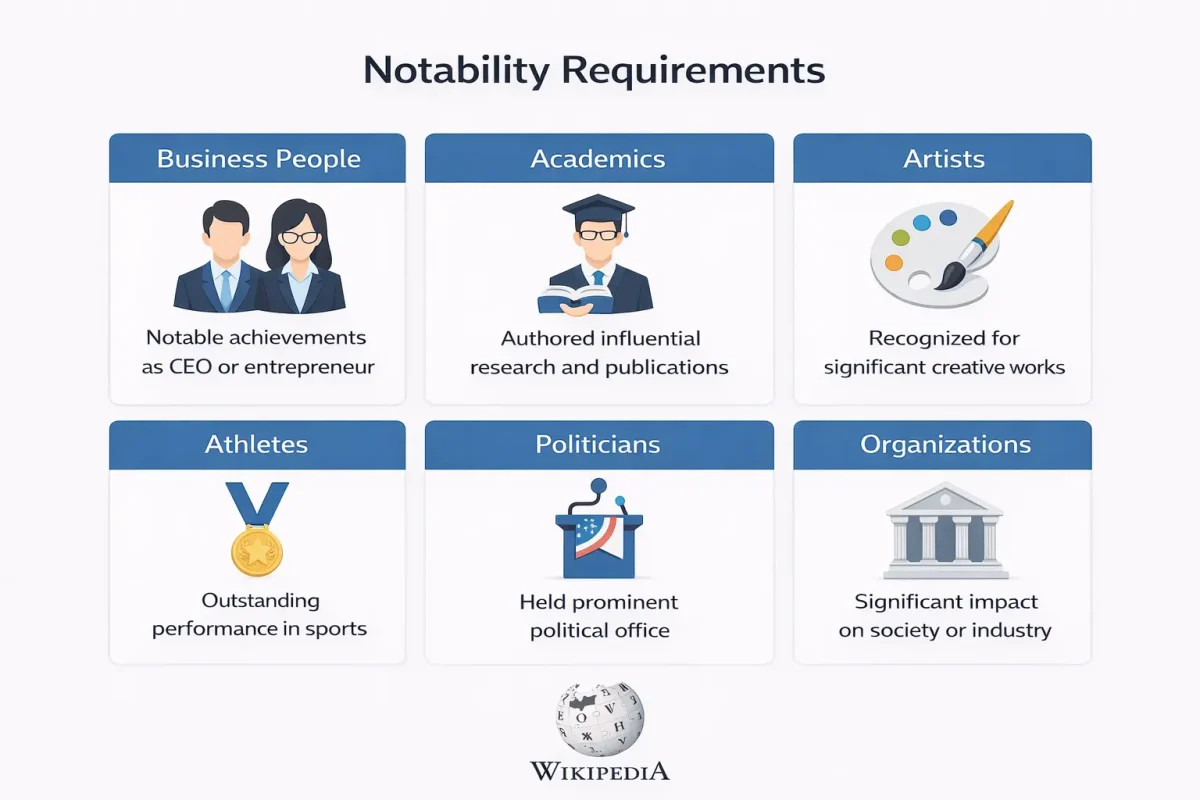
Beyond the general guideline, Wikipedia has specific notability criteria for different types of people.
Business People and Entrepreneurs
You need significant coverage in reliable business publications or major news outlets.
You likely qualify if:
- You’ve been profiled in Forbes, Bloomberg, Fortune, or major business journals
- You’re a CEO of a publicly traded company covered by financial media
- You’ve founded a company that achieved significant documented success covered by independent journalists
- You’ve received major industry recognition documented in reliable sources
You don’t qualify if:
- You’re successful locally but lack national media coverage
- Your only coverage is from press releases or paid PR
- You’ve only been mentioned briefly in business directories
- Your achievements are documented only on your company website
Even very wealthy business owners often don’t qualify if journalists haven’t independently chosen to write about them.
Academics and Researchers
You need documented impact in your field through publications and recognition.
You likely qualify if:
- You’ve published significant peer-reviewed research cited by other scholars
- You’ve received major academic awards or fellowships
- You hold or held prestigious academic positions documented in reliable sources
- Your work has been covered in academic publications or mainstream media discussing your research
You don’t qualify if:
- You have a PhD but haven’t published notable research
- Your work is known only within your small department or institution
- You’ve published in predatory journals without peer review
- Your only coverage is from your university’s press releases
Artists, Musicians, and Entertainers
You need documented commercial success or critical recognition.
You likely qualify if:
- You’ve released albums or art through major labels or galleries covered by reliable music or art critics
- You’ve won significant industry awards documented in reliable sources
- You’ve performed at major venues or festivals covered by established media
- Your work has been reviewed in established publications with editorial oversight
You don’t qualify if:
- You’re popular on social media but lack traditional media coverage
- You’ve self-released music or art without critical attention from reliable sources
- Your only coverage is from personal blogs or fan sites
- You’re well-known locally but haven’t achieved broader recognition
If you’re an artist trying to build your presence, consider our personal branding services to develop the credibility needed for future Wikipedia eligibility.
Athletes
You need participation at high competitive levels documented in reliable sports media.
You likely qualify if:
- You’ve competed at Olympic, World Championship, or top professional league levels
- You’ve won significant championships documented in established sports media
- You hold notable records covered by reliable sports journalists
- You’ve been profiled in major sports publications
You don’t qualify if:
- You compete at local or regional levels only
- Your achievements are documented only on team websites or personal pages
- You’re successful in amateur leagues without professional media coverage
Politicians and Public Figures
You need to hold or have held significant positions documented in reliable sources.
You likely qualify if:
- You’ve held national elected office or high-level government positions
- You’ve held state or provincial positions in major jurisdictions covered by reliable media
- You’ve been involved in significant political events documented by journalists
You don’t qualify if:
- You hold local positions like city council in small municipalities
- You’ve run for office but never won
- Your only coverage is from your own campaign materials
Even mayors of small cities often don’t qualify unless they’ve done something historically significant covered by independent media.
Notability Requirements for Organizations and Companies
Companies and organizations face stricter scrutiny than individuals.
Businesses and Corporations
You likely qualify if:
- You’re a publicly traded company covered regularly by financial media
- You’ve been the subject of detailed coverage in major business publications
- You’ve been involved in significant events (mergers, controversies, innovations) covered by independent journalists
- You’ve achieved significant market impact documented in reliable sources
You don’t qualify if:
- You’re a successful small or medium business without national media coverage
- Your only coverage is from business directories or press releases
- You’ve paid for articles in local business journals
- You’re profitable but journalists haven’t independently chosen to cover you
Most successful small businesses don’t qualify. Success and notability are different.
If you’re building your company’s online presence, our SEO services can help you gain visibility while you work toward building the media coverage needed for Wikipedia eligibility.
Non-Profit Organizations and NGOs
You likely qualify if:
- You’ve received significant media coverage about your work and impact
- You’ve been the subject of academic research or detailed reporting
- You’ve achieved documented significant impact covered by reliable sources
- You’ve received major grants or recognition documented in reliable publications
You don’t qualify if:
- You’re a small local charity without broader media attention
- Your only coverage is from your own newsletters or donor communications
- You’ve been mentioned briefly in local news without detailed coverage
Schools and Educational Institutions
You likely qualify if:
- You’re a university or college with significant documented history
- You’re a notable school that has received substantial independent coverage
- You’ve been involved in significant educational developments covered by reliable sources
You don’t qualify if:
- You’re a small private school without notable media coverage
- You’re newly established without documented impact
- Your only coverage is from local community news or your own materials
Special Notability Guidelines for Specific Fields
Wikipedia has additional specific guidelines for certain categories.
Authors and Writers
You need published books through established publishers or significant critical attention.
Multiple books from recognized publishers with documented sales or critical reviews qualify.
Self-published authors rarely qualify unless their work receives extraordinary independent critical attention.
Scientists and Medical Professionals
You need significant contributions documented in peer-reviewed literature.
Major discoveries, numerous highly-cited publications, or significant awards documented in reliable sources qualify.
Being a practicing doctor or scientist alone doesn’t qualify without documented notable contributions.
Internet Personalities and Content Creators
This is one of the hardest categories.
Social media following alone never qualifies. You need significant coverage in reliable sources about your work and impact.
Most YouTubers, TikTokers, and influencers don’t qualify even with millions of followers because reliable sources haven’t covered them substantially.
How to Self-Assess Your Wikipedia Notability
Use this checklist to evaluate honestly whether you meet notability requirements.
Source Quality Check
List every article written about you. For each, ask:
- Was this published by a major newspaper, established publication, or academic source?
- Does this source have editorial oversight and fact-checking?
- Is this source independent of me (not paid, not arranged by my PR team)?
- Does this article provide significant coverage (more than a brief mention)?
If you can’t answer yes to all four questions for at least 2-3 sources, you probably don’t meet notability yet.
Coverage Depth Check
Review the articles about you. Ask:
- Do at least 2-3 articles discuss me in depth (300+ words focused on me)?
- Do these articles address my achievements, not just mention me in passing?
- Were these articles written over time (not all from one event)?
If no, you need more coverage before attempting a Wikipedia page.
Independence Check
For each source, honestly evaluate:
- Did I pay for this article or coverage?
- Did my PR team arrange this interview?
- Is this from a publication I control or influence?
- Is this from a friend, colleague, or business partner?
If yes to any of these, that source doesn’t count toward notability.
Reliability Check
Evaluate each source’s credibility:
- Is this from an established publication with a reputation for accuracy?
- Does this publication have professional editors and fact-checkers?
- Would Wikipedia editors recognize this as a reliable source?
Small blogs, press release sites, and personal websites don’t count.
Common Notability Misconceptions
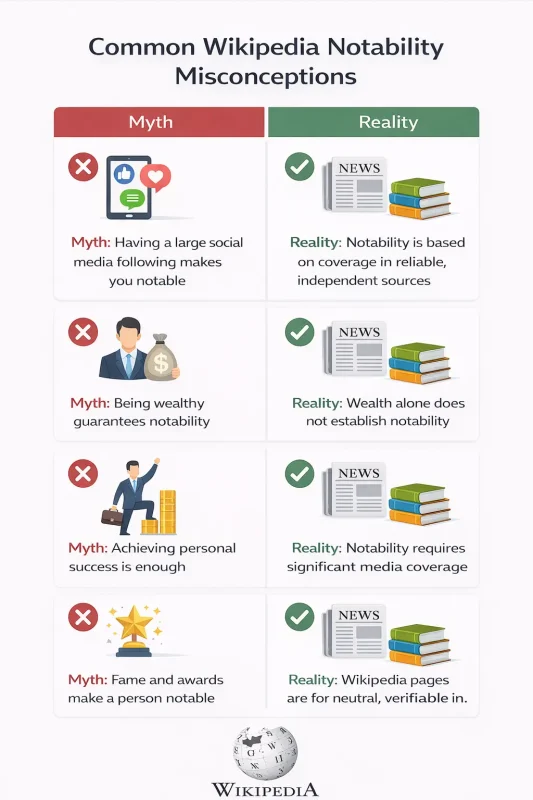
Misconception 1: “I’m Successful, So I’m Notable”
Success and notability are completely different.
You can be extremely successful, wealthy, and respected in your field while not meeting Wikipedia’s notability requirements.
Wikipedia cares about independent documentation, not actual importance.
Misconception 2: “I Have Millions of Social Media Followers”
Social media following never establishes notability.
Wikipedia wants coverage in reliable sources with editorial oversight. Instagram, TikTok, YouTube, and Twitter don’t count.
Misconception 3: “I Was in the News Once”
One news article isn’t enough.
Wikipedia wants sustained coverage from multiple independent sources over time.
Being interviewed once about your business doesn’t establish lasting notability.
Misconception 4: “My Industry Recognizes Me”
Industry recognition without independent media coverage doesn’t count.
You might be well-known among peers, but if journalists haven’t covered you, Wikipedia won’t accept you.
Misconception 5: “I Can Use Press Releases as Sources”
Press releases never count as reliable sources.
Even if major news sites republish your press release, it doesn’t establish notability.
Wikipedia wants independent journalism, not content you created.
What If You Don’t Meet Notability Requirements Yet?
If you don’t qualify now, don’t create a Wikipedia page. It will be deleted.
Instead, focus on building the coverage you need.
Build Media Relationships
Develop relationships with journalists in your industry.
Offer expert commentary on relevant topics.
Make yourself available as a source for stories they’re already working on.
Don’t pitch stories about yourself. Pitch valuable insights that happen to showcase your expertise.
Achieve Significant Milestones
Do things worth covering independently.
Launch innovative products. Conduct groundbreaking research. Win major awards. Achieve measurable impact.
Make it easy for journalists to see why you’re newsworthy.
Work with PR Professionals
Consider hiring a professional PR agency (not a Wikipedia creation service) to help you get genuine media coverage.
Good PR focuses on building real relationships and getting independent coverage, not creating promotional content.
Our PR agency services can help you develop media relationships and earn the coverage needed for future Wikipedia eligibility.
Document Everything
Keep a record of every article, interview, and media mention.
Save full copies of articles (publications disappear or change URLs).
Note publication dates, author names, and context.
This documentation will be crucial when you eventually qualify.
Be Patient
Building notability takes time.
Most notable people don’t qualify for Wikipedia until years into their career.
Focus on doing notable work. The coverage will follow.
When Should You Attempt a Wikipedia Page?
Only attempt a Wikipedia page when you clearly meet these criteria:
You have 5-7+ articles from reliable independent sources with significant coverage
These articles span at least 1-2 years (showing sustained interest)
The sources clearly document your achievements without your involvement
You can write about yourself neutrally or hire professionals to do it
If you’re unsure, get a professional assessment. Creating a page too early damages your chances later.
At Khan IT, we offer free eligibility assessments. We’ll review your coverage honestly and tell you whether you’re ready or what you need to build first.
Notability Requirements Are Strict for Good Reason
Wikipedia’s notability requirements feel harsh. They exclude many successful, accomplished people.
But these requirements serve an important purpose.
They ensure Wikipedia remains an encyclopedia of subjects the world considers important, not a directory of everyone who wants a page.
They prevent Wikipedia from becoming a promotional platform.
They maintain quality and reliability by requiring independent verification.
If you meet these requirements, Wikipedia can be a powerful credibility tool. If you don’t, focus on building the achievements and coverage needed to qualify later.
Need help understanding if you qualify? Contact Khan IT for a free notability assessment. We’ll review your coverage and give you an honest evaluation.
For more guidance on the Wikipedia creation process, read our complete guide on how to create a Wikipedia page for yourself.